Featured Posts

[Travel][feat1]

Afghan drought 'displacing more people than Taliban conflict'

octobre 16, 2018


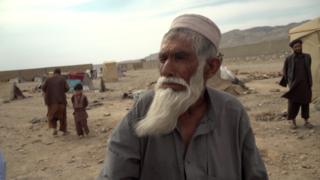
Shadi Mohammed, one of the inhabitants of a makeshift refugee camp in Herat
Image captionThe UN estimates that 260,000 Afghans have fled their homes this year due to drought
A deadly drought in Afghanistan is causing a humanitarian crisis that has displaced more people this year than the war between the government and the Taliban. The BBC's Secunder Kermani reports from Herat.
Shadi Mohammed, 70, wells up with tears as he walks through the makeshift camp on the outskirts of the western city of Herat, where he lives with his family.
"We are thirsty and hungry. We took what little we could with us, but lost most of it on the way. Now we have nothing. Eight of us live in this small tent," he says.
"My wife and my brother died. Half of our children are here. The other half were left behind."
Mr Mohammed is one of an estimated 260,000 people who have been forced from their homes in northern and western Afghanistan because of a severe drought in the region.
  • Protecting reporters on Afghanistan's deadly front line
  • The hell of losing loved ones in Afghanistan
The drought is adding to the misery in the country where levels of violence have been increasing since 2014 when international forces formally ended their combat mission.
The Taliban are now reported to control more territory in Afghanistan than at any time since the US led invasion which drove them from power in 2001.
But the UN says that this year, the drought has displaced more Afghans than even the conflict between the Taliban and the government.
Image captionThe drought is adding to the misery of Afghans who are already suffering in the war
Qadir Assemy from the United Nations World Food Programme (UNWFP) is helping co-ordinate the relief effort in Herat, which has seen an influx of people fleeing their homes.
"It's very challenging because of the scale of the disaster," he tells the BBC.
The UN is allocating $34.6m to help the 2.2 million people who are estimated to have been affected by the drought.
At present, the UNWFP is distributing money for people to buy food.
Image captionMany Afghans believe their political leaders are too detached from the issues facing them
Outside a registration centre, many seem desperate.
One woman sitting with four young children tells me she has recently arrived from the northern province of Faryab.
"If we had any money we would have never come here. Our bad luck brought us here," she says.
"There was no rain for more than a year. Everything dried up. We didn't even have water to give to our children. On top of that there was fighting between the Taliban and the army. It was chaos."
Others described being forced to sell their livestock or borrow money simply to survive. Agriculture is one of the country's main sources of income.
Image captionThe impending winter could worsen the situation in the refugee camps in Herat
The country is currently preparing for long-delayed parliamentary elections scheduled for 20 October.
But many Afghans complain that their political leaders are too detached from the issues facing them.
The tens of thousands of people in Herat certainly have a more pressing concern at hand - the impending arrival of the cold winter months.
Mr Assemy believes the cold weather is "a major concern" as it seems unlikely that the displaced people will be able to return to their homes in the coming months.
"The weather will be very harsh. This population will not be able to survive in tents," he says.
Afghan drought 'displacing more people than Taliban conflict' Afghan drought 'displacing more people than Taliban conflict' Reviewed by Unknown on octobre 16, 2018 Rating: 5

Paddington station: Passengers warned of major disruption

octobre 16, 2018


heathrow express
Image captionThe Heathrow Express service is also not running
Passengers have been warned to expect major disruption this morning at one of London's busiest railway stations.
Network Rail said all Great Western Railway (GWR) trains running between Paddington and Slough had been cancelled until at least midday after overhead electric cables were damaged at Ealing on Tuesday night.
Trains between Paddington and Heathrow airport are also not running.
Services were likely to be affected all day, Network Rail added.
There were also major delays for commuters using Victoria Station on Tuesday evening after an electricity supply failure.
GWR said damage to the overhead wires had left many trains stranded on the line between Paddington and Reading.
"Owing to the extent of the damage, no trains are expected to be able to operate between London Paddington and Hayes & Harlington in either direction for much of Wednesday," the operator said.
"As a result, GWR, TfL Rail and Heathrow Express will not be operating a train service between London Paddington, Hayes & Harlington or Slough until such time as repairs have been completed."
Network Rail said it was "working to recover all the stranded trains and to rectify the damage to the overhead electric wires".
It said it hoped to reopen two of the four affected lines from midday, but GWR advised passengers not to attempt to travel between Paddington and Slough until at least 12:00 BST.
Paddington station: Passengers warned of major disruption Paddington station: Passengers warned of major disruption Reviewed by Unknown on octobre 16, 2018 Rating: 5
‘School for politicians’ gets a taste of power

octobre 16, 2018

RenovaBR studentsImage copyrightRENOVABR
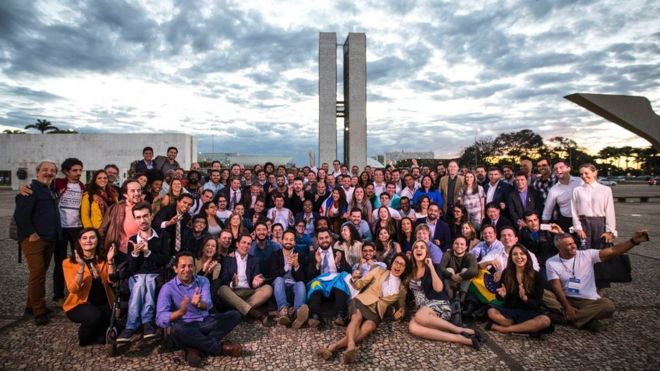
Image captionOnly 133 out of 4,000 candidates were selected for the latest RenovaBR courses
Business people who are sick of corruption in Brazil have come together to school a new generation of politicians.
They set up a group called RenovaBR, based in Sao Paulo, which has so far had 16 of its "students" elected to national and state legislative bodies.
Three of those students were elected to Brazil's Congress in the latest general election.

Rigged game

Brazil has been rocked by a series of high-profile corruption scandals in recent years.
In the Odebrecht scandal, which the US Department of Justice called "the largest foreign bribery case in history", investigators uncovered payments from the Brazilian construction giant to dozens of politicians.
The firm had even developed software to help make those payments more efficient.
In December 2016 Odebrecht and Braskem, a petrochemical company, paid $3.5bn in fines.
Dozens of other companies have been accused of illegal donations to politicians in Brazil: typically a large amount of money, which could be from corrupt sources, is used to fund lavishly expensive political campaigns. This makes it very difficult for newcomers to successfully run for office.
Incumbent politicians also have immunity from prosecution for most criminal offences, so unless they are voted out, there are very few options to replace them.
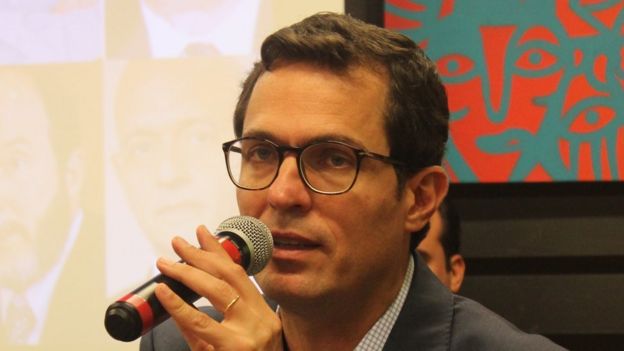
Eduardo Mufarej
Image captionEntrepreneur Eduardo Mufarej came up with the RenovaBR concept
Last year some business leaders decided to act.
Eduardo Mufarej, a young entrepreneur with a successful career in private equity, came up with the concept of RenovaBR ("Renew Brazil"), an unusual mixture of social movement and training course.
"We know very high quality individuals that have graduated in places like Oxford and Harvard, and even people without such formal education, but that have extraordinary paths and careers. These are the people who should be our representatives", says Mr Mufarej.
More than 4,000 people applied for the course he set up.
RenovaBR analysed CVs, ran background checks and interviewed candidates to make sure they fitted the profile of the "new politician" they were looking for.
Only 133 were selected for the latest courses, which ran from January to June.
"We needed to see three things in our candidates," Mr Mufarej says.
"First of all, resilience: someone who has gone through things in life and hasn't given up.
"Second is a history of delivering, and not just talking. We need people who can roll up their sleeves and get things done.
"And the third is the willingness to serve. People need to understand that when they are elected for office they are being hired for a job."
Mr Mufarej brought in specialists to teach courses such as how to run a campaign in the digital era, how to recruit and lead teams, and how to get laws approved in Brazil's byzantine legislative system.
In total, students went through 220 hours of classes.
Next month the 16 politicians that got elected with the help of RenovaBR will take a new course on how to transform their ideas into practice.
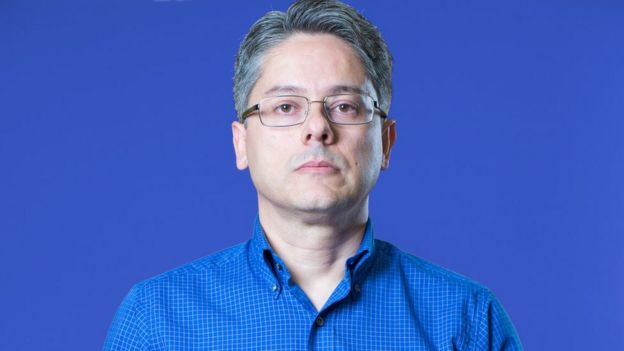
Alessandro VieiraImage copyrightHENRIQUE GRANDI
Image captionAlessandro Vieira ran against the governor who sacked him
The new politicians had to be extremely driven to achieve what people in RenovaBR call "the little miracle" of being elected in a game that favours old hands.
This was the case for Alessandro Vieira, a police chief from Sergipe who ran for senator against the very same governor who fired him.
Mr Vieira was sacked a year ago after his team uncovered a massive corruption scheme involving rubbish collection contracts.
"I ran for senator against the sitting governor, a senator who had been 24 years in office, the leader of the current government in Congress, the president of the traditional Workers' Party and a popular church leader," says Mr Vieira. "Their campaigns combined cost over 8 million reais (£1.6m). My campaign cost 80,000 (£1,600)".
Mr Vieira fits a profile that has good potential with voters: he had tried to tackle corruption and lost his job in the process. But he lacked experience and funding.
At first Mr Vieira tried using Facebook posts but decided it was not working. So he produced low-budget videos with simple messages instead. RenovaBR helped him put together a team of 2,000 volunteers who spread his videos online.
It paid off and Mr Vieira won, gaining almost half a million votes.
Joenia WapixanaImage copyrightSARA DE SANTIS
Image captionIndigenous rights activist and lawyer Joenia Wapixana was elected to Congress
Joenia Wapixana is the first female indigenous Congresswoman in Brazil's history.
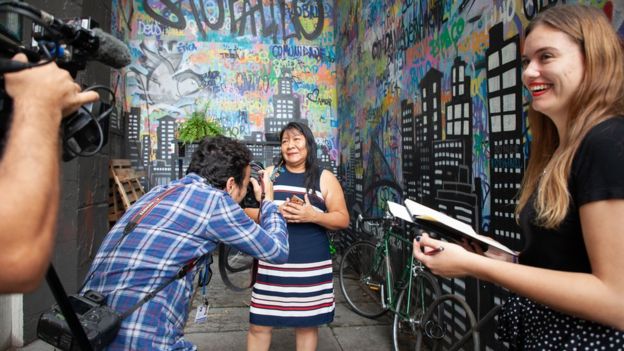
In the Northernmost state of Roraima, she works as a lawyer and activist for the preservation of indigenous Brazilians in one of the most conflict-stricken areas of the country.
Ms Wapixana was asked by a local council of indigenous people to run for office but she had no idea how to organise a campaign. RenovaBR helped her get the votes needed.
She says a new course will give her tools in her fight against mining projects that have been moving into indigenous lands in the Amazon region.
"Now I know exactly all the anti-indigenous bills that are already going forward in Congress and I can effectively work against them."

Same old story?

Despite its intentions to renew Brazilian politics, RenovaBR also represents a continuation of some old traditions.
Out of 16 politicians, only one, Ms Wapixana, is indigenous, and there are only three women in the group. The overwhelming majority of politicians are men from the rich Southern states.
There is also a pro-business bias - with half of the elected belonging to Novo, a party formed largely by entrepreneurs.
Mr Mufarej acknowledges RenovaBR's shortcomings and says this is just the beginning of the project.
In future elections he hopes to get a more diverse mix of candidates.
Also he is keen to stress that MPs will have complete freedom to act according to what they promised their voters - and not as a sort of lobby group for the entrepreneurs behind RenovaBR.
Also there is no way to secure that all 16 politicians will live up to their promise of renewing politics.
"Their only commitment to us is to complete their terms, to act with transparency and responsibility. If they don't, they may get a call from me soon," he says.
‘School for politicians’ gets a taste of power ‘School for politicians’ gets a taste of power Reviewed by Unknown on octobre 16, 2018 Rating: 5
Irish nationalist soldiers commemorated in France

octobre 16, 2018


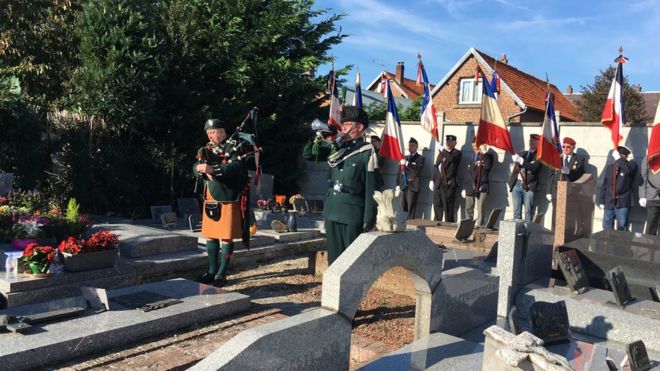
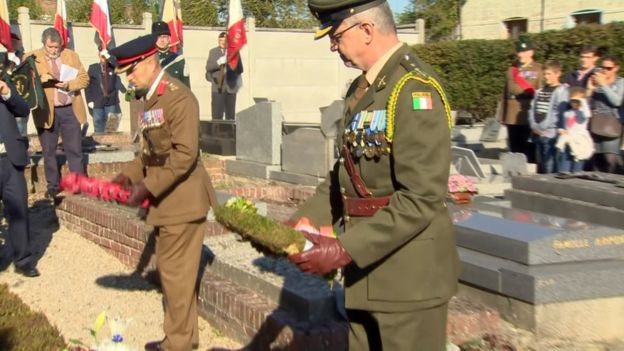
The ceremony in Ronssoy involved a dedication of a plaque to the battalion
Image captionThe ceremony in Ronssoy involved a dedication of a plaque to the battalion
The second of two joint services of remembrance for soldiers from Ireland who fought and died in World War One has taken place in northern France.
On Saturday, the 36th Ulster Division was commemorated in Belgium.
On Sunday, it was the turn of nationalist soldiers from the Falls Road in the 6th Connaught Rangers.
The ceremony in Ronssoy involved a dedication of a plaque to the battalion.
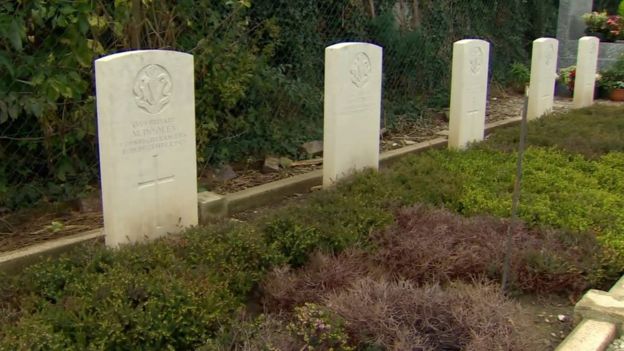
Graves
Image captionMany of the soldiers who survived were ostracised or remained silent about their experiences at war
About 600 men enlisted to fight for the British Army in the hope of showing Ireland could be trusted with Home Rule.
However, on their return, far from finding a country ruled by a 32-county parliament, many were ostracised or remained silent about their experiences and subsequently supported the republican cause.
The 6th Connaught Rangers Research Group, based in west Belfast, has carried out extensive work on the many nationalists who went to war in Europe.
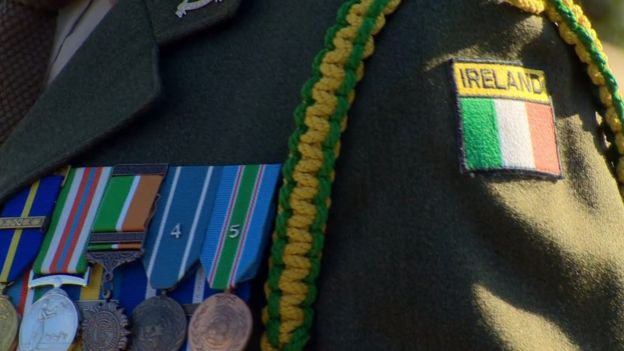
Badge
Image captionThe event was attended by members of the Irish and British Army
Members of the group gathered in the small village of Ronssoy on Sunday morning to lay wreaths and remember the sacrifices of those soldiers.
As well as a laurel wreath laid by a representative of the Irish Army, poppy wreathes were laid by a member of the British armed forces.
Both nationalists and unionists were represented at each of the weekend's ceremonies.
Wreathes laid
Image captionBoth a laurel wreath and a poppy wreath were dedicated at the ceremony
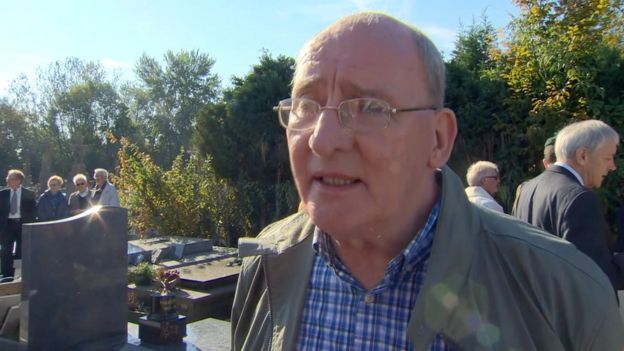
Harry Donaghy of the 6th Connaught Rangers Research Group, told BBC News NI its members feel it is important that the nationalist soldiers' contribution is remembered.
"No one would deny that it still has a resonance," said Mr Donaghy.
"Bitterness is a very difficult thing to expunge from our political calendar, but I would argue that, in the main, there has been an understanding and acceptance of something that was ignored or forgotten about for almost 100 years.
Harry Donaghy said it is important the nationalist soldiers' contribution is remembered
Image captionHarry Donaghy said it is important the nationalist soldiers' contribution is remembered
"Now, nationalism has a maturity and understanding that this is part of Irish nationalist history."
The weekend marked the culmination of two years of events, which began with the centenary of the Battle of the Somme on 1 July, 2016.
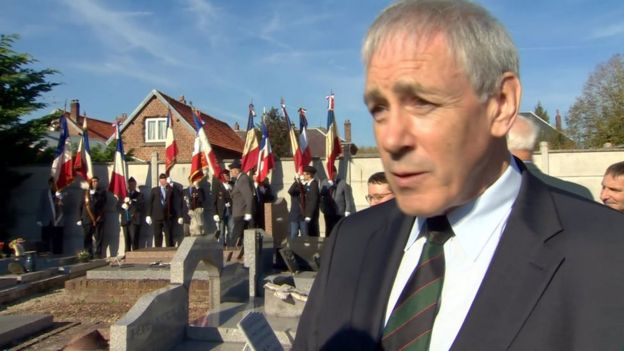
Alan McFarland, chair of the Somme Association, said Sunday's ceremony was "a unique event".
"We've got the two traditions here, we have a cross-border tradition here today, the Irish Army, the British Army.
Alan McFarland
Image captionAlan McFarland of the Somme Association said the ceremony was "a unique event"
"These things are very important in terms of letting people explore their own background.
"We've been working for 25 years, looking at the First World War, because it's the last time the two traditions in Ireland fought in common cause and it's a good vehicle to allow people to explore their own history."
The exhortation at Sunday's Act of Remembrance, "They shall not grow old, as we that are left grow old," was read out in Irish as well as English.
BBC News NI reporter Mervyn Jess, who attended the events, said the exhortation "says a lot about the way things have unfurled and have been unpackaged over this past couple of years around the Somme".
Irish nationalist soldiers commemorated in France Irish nationalist soldiers commemorated in France Reviewed by Unknown on octobre 16, 2018 Rating: 5
Missing pianist believed to be buried by wrong family

octobre 16, 2018


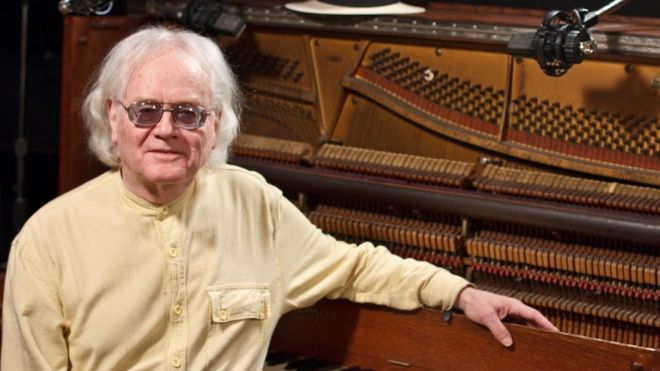
Pianist Scott CushnieImage copyrightSUBMITTED BY ANDREA REID
Image captionPianist Scott Cushnie
A grieving Canadian family has accidentally buried the wrong body.
It was an error that only came to light when the missing relative thought to have died returned home months after the funeral.
Police believe the body belonged to pianist Scott Cushnie, 80, who has been missing since August.
Friends and family of the Toronto musician say if he were alive, he would have "had a laugh" and they hold no hard feelings towards the other family.
The coroner's office says the body is being exhumed so a full identification can be carried out.

How did the mix-up happen?

Mr Cushnie's long-time friend Andrea Reid told the BBC that she got a call from police last week explaining that they believed they had found him - and that they thought he had been accidentally buried by the wrong family.
Police told Ms Reid a man died in hospital last August, after an ambulance driver spotted him falling on the sidewalk.
  • Mistaken identity as Pakistan embarrassed by wallet theft
  • Locked up in Canada over name mix-up
  • The boy who wrote his own obituary
Meanwhile, another family was also searching for their loved one. Police called them to identify the body in the morgue, and the body was released to their care. Police have not identified the family for privacy reasons.
"When he died he was released to his family and they made funeral arrangements," police spokeswoman Jenifferjit Sidhu confirmed.

How the families were told

Months later, the man the family thought they had buried returned alive, leading police to contact Ms Reid, who had been leading the search for Mr Cushnie.
"In a lot of ways this was actually a big relief, because I wasn't under the impression that he was alive any more and my fears about what could have happened to him were running rampant," she said.
"To know that an ambulance was right there when he had his accident, and he was given immediate care, and he's been cared for this whole time, was actually a really nice comfort."

Who was Mr Cushnie?

Mr Cushnie was well known in Toronto's music community. Born legally blind, he played piano professionally in blues and rock bands since the 1950s, and shared the stage with greats such as Aerosmith and Duane Allman.
Scott Cushnie has played piano professionally since the 1950sImage copyrightSUBMITTED BY ANDREA REID
Image captionScott Cushnie (foreground) has played piano professionally since the 1950s
Ms Reid formed a close friendship with Mr Cushnie over music. He became her piano mentor and taught her the blues. She also became his de-facto manager, helping him book gigs and get to appointments.
He was living in an independent senior's flat in Toronto when he went missing, and was in good health.
Mr Cushnie leaves behind two sisters and several nieces and nephews.

A need for closure

"It is such a strange situation," said his niece Liz Hale. "We'd like to talk to that other family."
Ms Hale said there is no ill will about the mistake, but that speaking to them would help give them closure.
"My mom and his other sister especially are really saddened by it all, and we are just hoping that we can move on, and celebrate his life with his friends and fellow musicians."
The coroner's office is still working on identifying the body that was buried, but Ms Reid says there is little doubt in her mind that it is him. She saw some of the effects that were collected, and recognised his house keys.
Ultimately, she believes Mr Cushnie would find the mistaken burial funny.
"He was a man with an incredible sense of humour... if he had read about this story he would have had a laugh," she said.
Missing pianist believed to be buried by wrong family Missing pianist believed to be buried by wrong family Reviewed by Unknown on octobre 16, 2018 Rating: 5
Fourni par Blogger.